

Risk Management · 2025
In this section2 topics
Risk Management Policy & Plan
Policy & Plan Description
Risk Management
The Company is aware of the importance of risk management under changes from internal and external factors that may affect the business both in the short term and long term. So, The Company committed to managing corporate risks in a way that is linked to strategic management as well as preparing and reviewing the acceptable risk (Risk Appetite) and the acceptable deviation level (Tolerance) to help define the framework for assessing alternatives and selecting suitable strategies and supporting business operations to achieve strategic goals and business objectives and create sustainability. We applied the framework of COSO Enterprise Risk Management as a risk management guildline at the corporate level, business level, operational level including issues of environmental, society and governance as a guideline for managing risks that may affect the achievement of the Company's objectives and goals including applying risk management to create sustainable business opportunities both current and in the future.
Risk Management Structure
The company systematically manages risks through the Risk Management Committee and management units. In order to define strategies, action plans, and various measures to ensure that risk management is integrated effectively and efficiently in alignment with the Company’s goals and strategies on a continuous basis. The current structure and working committees responsible for the Company’s risk management are as follows.
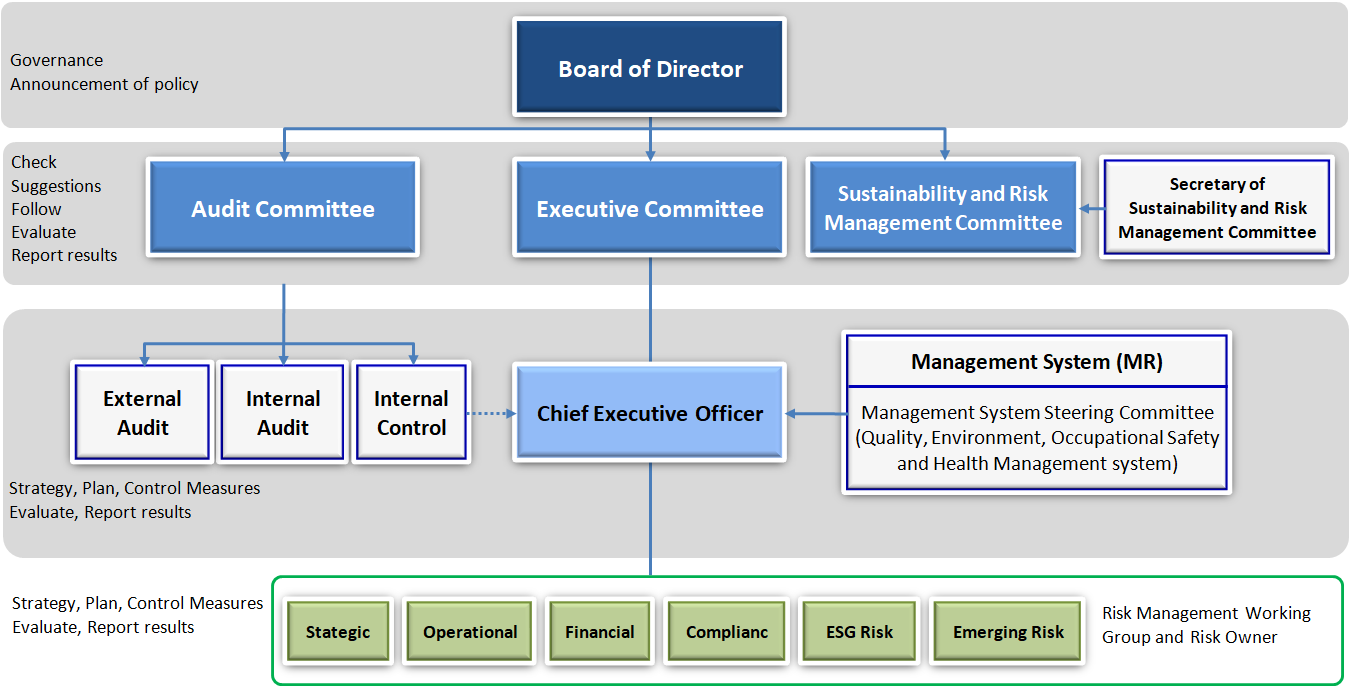
Responsibilities
1) Board of Directors Determines direction of the organization, approves work plans and frameworks of sustainability.
2) Sustainability and Risk Management Committee: Responsible for establishing sustainability and risk management policies; jointly designing and developing the Company’s sustainability framework; preparing action plans and monitoring their implementation; assessing the adequacy and appropriateness of sustainability and risk management plans; and reporting significant matters to the Board of Directors.
3) Risk Management Working Group and Risk Owners: Co-determine strategies, plans, and measures in the area of sustainability together with the risk owners of each department including Co-setting a sustainability framework and measuring performance based on sustainability indicators related to each operational division or department and linking the work functions to the business plan with sustainability goal.
4) Secretary to the Sustainability and Risk Management Committee Responsible for coordinating sustainability and risk management matters in close collaboration with the Sustainability and Risk Management Working Team and the Sustainability and Risk Management Committee, to ensure the effective implementation of sustainability and risk management policies and action plans, and for reporting risk matters to the Sustainability and Risk Management Committee.
Tools for Risk Management
The Company has studied and applied risk management tools in various forms, for example, determining the level of risk that the organization can accept (Risk Appetite), assessing and prioritizing risk factors using a risk map, monitoring risk management through a Mitigation Plan and key risk indicators (KRI). In addition, the company also monitors the changes of important external factors including emerging risks in order to be able to prepare proactive risk management measures before they affect the business of the company.
The company has analyzed both internal and external environment including trends in economy, society, politics, technology, industry, marketing, competitors, expectations of relevant stakeholders to define corporate level risk factors that may have an impact on the Company and significant stakeholders. The Company's risk management policy covers the following important issues:
Risk Management Policy
The Company’s risk management policy covers the following key areas:
1) Fostering a shared understanding, awareness, and responsibility to build a shared understanding, awareness, and responsibility regarding risks, controls, and the impact of risks on the company within the management and operational processes for all employees and executives at every level throughout the organization.
2) Implementing a comprehensive risk management framework to have a high-quality, appropriate, and sufficient risk management process, approach, and measures at an international standard. This includes continuous and regular identification, analysis, assessment, prioritization, management, control, monitoring, reporting, evaluation, and communication of risk information throughout the company.
3) Conducting both qualitative and quantitative risk assessments to establish qualitative risk assessments, such as the company’s reputation and image, and quantitative risk assessments, such as loss of revenue and increased expenses, while considering the likelihood and impact of each risk.
4) Defining the organization's risk tolerance to define the company's risk tolerance to limit potential damage to an acceptable level. This also includes setting warning signs events or risk levels that alert employees to take specific actions to ensure risks do not exceed the defined risk ceiling.
5) Ensuring cost-effective risk management to manage risks within acceptable criteria, in line with the company’s policies, and to ensure they are appropriate based on the costs and benefits derived.
6) Documenting standard operating procedures to provide written standard operating procedures (SOPs) for executives and employees to follow this helps control operational risks.
In the year 2025, the Risk Management Committee has assessed, controlled, and monitored risk management in all aspects both strategic risks, operational risks, compliance risks, including sustainability development risks, and new risk trends, overall risks in all aspects of the Company at a level that can be managed. The identified risks are assessed from the current situation. However, there may be other risks that the Company is unable to predict at the present time or the risks that the Company considered at the moment that do not have any significant impact on the Company’s business operations according to the analysis and description of the management transparently disclosing to data user.
Policy Document Link
https://www.adb.co.th/wp-content/uploads/2025/11/20_Risk_EN.pdf
Page Number in Report
3
Risks to the Company's Business Operations
Risk Register
| Risk Name | Risk Characteristics | Consequences | Management Measures | Related Risk Factors |
|---|---|---|---|---|
| Strategic and Operational Risks | 1) High Market Competition As the domestic market has shrunk due to the economic situation, competitors have to find more markets than before, resulting in the company having more competitors in the market segments in which the company specializes. 2) U.S. Tax Policy The risks arising from President Trump’s tax policy in 2025 have impacted the Company’s overall business operations. These impacts can be summarized into three main dimensions: export tariff barriers, import dumping crises, and pressure to restructure the production and supply chain. 3) Geopolitical Issues Risks have arisen from economic polarization, leading to trade barriers on both raw materials and technology. Additional challenges stem from the energy and logistics crises caused by the prolonged Russia–Ukraine conflict, the Israel–Palestine war, disruptions to shipping in the Red Sea, and the influx of Chinese products into Thailand. 4) Economic Recession Both at the global and domestic levels, as the Company’s products are upstream products closely linked to the construction and automotive industries, which are highly sensitive to economic conditions. This risk has led to a slowdown in the real estate and construction sectors, a decline in consumer purchasing power due to the high cost of living, causing consumers to postpone purchases of durable goods such as automobiles and electrical appliances, and an oversupply situation. While demand has weakened, new production capacity from China continues to enter the market, resulting in an “oversupplied market” and intensified price competition. 5) Climate Change The Company’s business involves the use of raw materials associated with the petrochemical industry, which is characterized by relatively high greenhouse gas emissions and environmental impacts. Currently, climate change issues are clearly evident worldwide. This risk affects the Company in multiple areas, including raw material management and the supply chain, the need to drive and advance innovation in response to growing environmental awareness among consumers, compliance with business and product regulations, carbon tax measures, as well as the Company’s image and reputation. | 1) High Market Competition
2) U.S. Tax Policy A slowdown in production due to uncertainty regarding forthcoming tariff rate announcements.
3) Geopolitical Issues
4) Economic Recession
5) Climate Change
| 1) High Market Competition
2) U.S. Tax Policy
3) Geopolitical Issues
4) Economic Recession
5) Climate Change
| 1714 · Description: Competition risk · Info category: STRATEGIC_RISK · 1715 · Description: Economic risk · Info category: STRATEGIC_RISK · 1719 · Description: Climate change and disasters · Info category: STRATEGIC_RISK · 737 · Other name: U.S. tax policy · Description: Other · Info category: STRATEGIC_RISK |
| Legal and Regulatory Risks | In the past, the Company has established anti-corruption policies and measures, internal control systems, and monitoring mechanisms to ensure compliance, enforcement, protection, and strict adherence to the Code of Ethics and Code of Conduct. Clear rules and operating procedures have been implemented in accordance with applicable laws to prevent corruption. The Company has also designated responsible officers to monitor and oversee various channels provided for whistleblowing and the reporting of misconduct or complaints. In addition, the Company has established systematic and fair processes for handling complaints, protecting whistleblowers, reporting outcomes, and informing complainants in accordance with the Company’s regulations, with such guidelines publicly disclosed on the Company’s website. However, given the nature of the industry in which the Company operates, laws and regulations requiring close monitoring include those related to environmental protection, labor and human rights, as well as occupational health and safety. Compliance with these regulations therefore represents one of the Company’s key operational risks. |
|
| 758 · Description: Violations of laws and regulations · Info category: COMPLIANCE_RISK |
| Management and Operational Risks | 1) Enhancing Employee Capabilities and Upskilling Human resource development is considered one of the Company’s key risks, as the business relies significantly on labor in its production processes. Currently, labor costs represent a major cost component. Workforce reductions in certain positions or functions, implemented to improve operational efficiency, require existing employees to possess broader, multi-skilled expertise. Therefore, enhancing employee skills is essential to prevent operational issues, delays, and limitations on long-term growth and competitiveness. 2) Process Improvement At present, the Company operates with multiple systems, workflows, operating procedures, rules, and regulations. Some activities have been newly introduced to comply with policies, regulatory requirements, customer expectations, system requirements, and reporting and public disclosure obligations. As certain tasks are relatively new, inter-process continuity and seamless coordination among departments have not yet been fully achieved. 3) Internal Communication Risks arising from ineffective internal communication may lead to various issues, such as information silos between departments (silo communication), information distortion, communication delays, and a lack of two-way communication channels or feedback loops. | 1) Enhancing Employee Capabilities and Upskilling
2) Process Improvement
3) Internal Communication
| 1) Enhancing Employee Capabilities and Upskilling
2) Process Improvement
3) Internal Communication
| 755 · Other name: Enhancing employee capabilities and upskilling, as well as improving work processes and internal communication · Description: Other · Info category: OPERATIONAL_RISK |
| Financial Risk | 1) Default on debt repayment Trade wars and the global economic crisis have led to an economic downturn, inflation, high interest rates, Exchange rate volatility and domestic political uncertainty causing the Company's customers to be affected by liquidity. This has a significant impact on customers' ability to repay debts and significantly affects the Company's finances, operations, and risk management. 2) Financial performance The risk that the Company may be unable to achieve its established financial targets (such as net profit, revenue, or return on investment), and/or may experience earnings volatility that could affect business stability. This risk is of the highest significance to the Company, as profitability is often under pressure from raw material prices and prevailing economic conditions. 3) New business investment Such as, investments in new businesses such as ADB Bio, as well as future investments, may be exposed to various risks, including market and demand risks, where new products may not receive the expected market acceptance or target markets may grow more slowly than projected; technical and expertise risks; and financial and payback risks. In cases of cost overruns or prolonged product development timelines, these factors may adversely impact the Company’s overall cash flow. | 1) Default on debt repayment
2) Financial performance
3) New business investment
| 1) Default on debt repayment
2) Financial performance
3) New business investment
| 763 · Description: Default on payment or exchange of goods · Info category: FINANCIAL_RISK · 1725 · Description: Income volatility · Info category: FINANCIAL_RISK · 767 · Other name: New Business Investment · Description: Other · Info category: FINANCIAL_RISK |